On this page
10K means 10 parts gold out of 24 — about 41.7% pure
Karat measures purity in 24ths. 10K is 10 parts gold and 14 parts alloy metals — usually copper, silver, and a touch of zinc to give it color and hardness. 10 ÷ 24 ≈ 41.7%, so a 10K item is 41.7% gold by weight. The decimal stamp '417' means the same thing. 10K is the floor for legal 'gold' marking in the US — anything below 10K can't be sold as gold here, though European pieces marked 8K or 9K do exist and we evaluate them as fractional-karat gold.
Where 10K shows up: class rings, mass-market chains, budget jewelry
10K is the most common karat for high-school and college class rings — the higher alloy content makes it hard enough for daily wear without scratching or denting. You'll also find 10K on mid-market chains (Macy's, Kay's, Helzberg), budget department-store pieces, and older costume-grade gold from the 1970s–1990s. Counterfeiters sometimes stamp 10K on gold-plated base metal, which is why we test every stamp before pricing — a 10-second acid test reveals the truth.
The math: weight × 41.7% × today's spot price
Here's how every honest counter calculates 10K value. Start with the troy-ounce gold spot price (public, updated by the second). Divide by 31.1035 to get the per-gram price for pure gold. Multiply by 0.417 to get the per-gram price for 10K. Multiply by your item's verified weight in grams. That's the melt value. Worked example: at $2,400/oz gold, an 8g 10K class ring is worth 8 × ($2,400 ÷ 31.1035) × 0.417 ≈ $257 in melt content. The actual offer on scrap runs 70–80% of that — typically $180–$206 — to cover refining cost, market hedge, and counter margin.
What we do at the Gaslamp Quarter counter
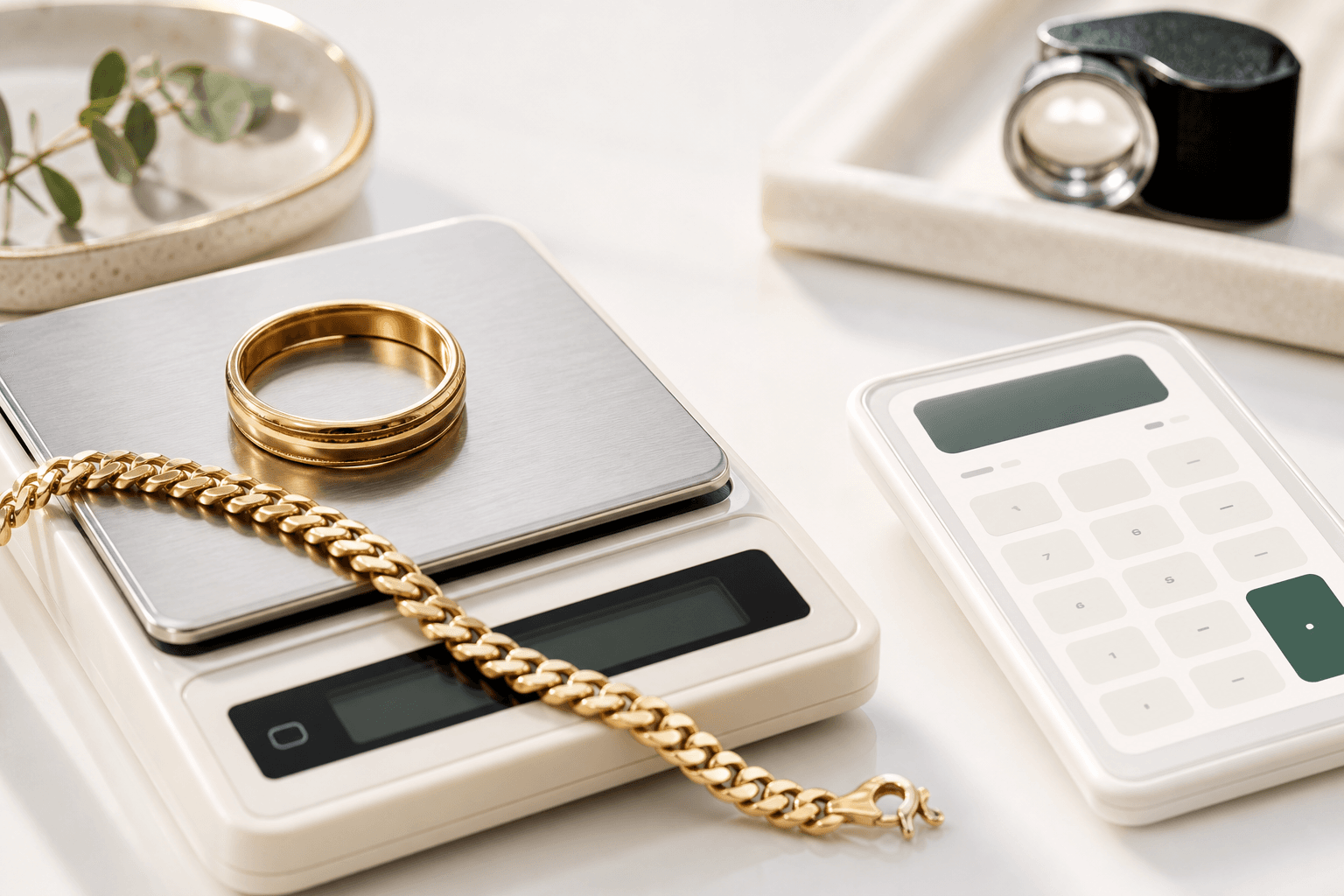
When you bring a 10K piece into our San Diego counter, we re-weigh on a calibrated 0.01g jeweler's scale (kitchen scales drift), acid-test or XRF-test the stamp (10K stamps are often legitimate but sometimes applied to plated bases), then run the math live against today's Gold API spot price. You see every step. If your piece is a recognizable signed brand or a vintage piece in good condition, we evaluate it as a piece — not as scrap — and the offer can run above 80% of melt. Class rings, broken chains, single earrings — all welcome, all priced by the same transparent math.
How Much Is 10K Gold Worth in San Diego Today? FAQ
Is 10K gold worth less than 14K?
Yes, per gram. At the same weight, 14K is 58.5% gold vs 10K's 41.7%, so 14K's melt value runs about 40% higher than 10K's. Both have real value — just less per gram at lower karats. If you have a mix of karats, bring them all and we'll sort on the counter.
Do you buy class rings?
Yes. Class rings are almost always 10K, and we see them constantly. Bring the ring as-is — you don't need to remove the stone (it's usually synthetic and doesn't affect gold value). We weigh, test, and price the gold content; you keep the stone if you want it.
What if my 10K piece is broken or tangled?
Condition doesn't reduce metal value at all. A snapped chain, single earring, or dented ring is priced by the same per-gram math as a perfect piece. Don't try to clean or polish anything beforehand — amateur cleaning can damage stamps and make testing harder.
Are some 10K pieces worth more than scrap melt?
Occasionally. Signed designer 10K pieces, vintage Art Deco 10K, or pieces with collectible stones can earn above scrap. We tell you when that's the case. For generic 10K chains and broken jewelry, the math is straightforward melt-based.
What's the lowest karat the US treats as gold?
10K. Below that (8K, 9K, common in European jewelry) is still sellable but not legally marketable as 'gold' in the United States. We still buy it and pay for the actual gold content; the karat just gets explained on the counter.