On this page
14K means 14 parts gold out of 24 — about 58.5% pure
Karat measures purity in 24ths. 14K is 14 parts gold and 10 parts alloy metals (typically copper, silver, and zinc), or 14 ÷ 24 ≈ 58.5%. The European decimal stamp 585 means exactly the same thing — both refer to 58.5% gold content. American jewelry overwhelmingly uses 14K because it's the sweet spot: enough gold to look unmistakably gold, but enough alloy to be hard enough for daily-wear chains and rings without bending or scratching like 18K or 22K would.
The math: weight × 58.5% × today's spot price
Here's how every honest counter calculates 14K value. Start with the troy-ounce gold spot price (public, updated by the second on any market feed). Divide by 31.1035 to get the per-gram price for pure gold. Multiply by 0.585 to get the per-gram price for 14K. Multiply by the item's verified weight in grams. That's the melt value. Example: at $2,400/oz gold, a 10g 14K chain is worth 10 × ($2,400 ÷ 31.1035) × 0.585 ≈ $451 in pure melt content. The actual offer on scrap will be 70–80% of that — typically $315–$361 — to cover the refining cost, market hedge, and counter margin.
What the San Diego counter does differently
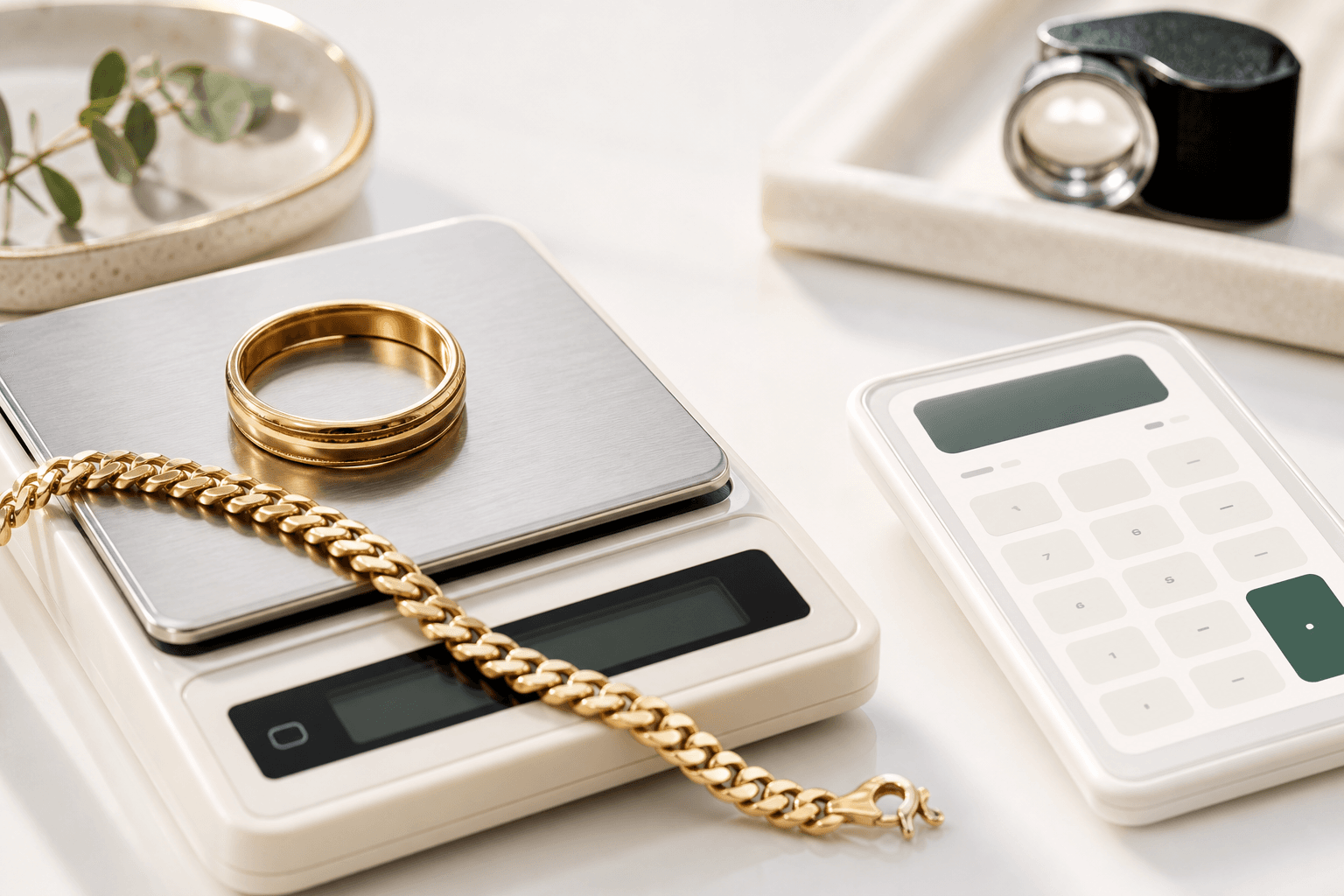
When you bring a 14K piece into our Gaslamp Quarter counter, we re-weigh on a calibrated 0.01g jeweler's scale (kitchen scales drift; ours is checked monthly), confirm the 14K stamp with an acid or XRF test (stamps can be wrong, worn, or fake), then run the math live against today's Gold API spot. You watch every step. We walk you through all four numbers before we name an offer. If your piece is a recognized designer mark (Tiffany, Cartier, David Yurman) or a clean estate piece in good condition, we evaluate it as a piece — not as scrap — and the offer can run well above the 80% melt ceiling.
Why we test the stamp instead of trusting it
A 14K stamp isn't proof — it's a starting hypothesis. Stamps can be worn down to illegibility, applied to gold-plated bases by counterfeiters, or affected by jeweler repairs that mix karats inside one piece. A 5-second acid test or 15-second XRF reading tells us what the metal actually is, regardless of what's stamped. If your piece tests at 10K despite the 14K stamp, we tell you and explain what changes; if it tests above 14K, you get paid for the higher purity. We've never met a seller who wanted us to skip the test.
How Much Is 14K Gold Worth in San Diego Today? FAQ
What does 585 mean on gold jewelry?
585 is the decimal equivalent of 14K — both refer to 58.5% pure gold by weight. European, Italian, and some Asian manufacturers use the 585 stamp; American manufacturers typically use 14K. Same metal, same per-gram value, just different conventions for marking it.
Can a 14K stamp be wrong?
Yes, more often than people expect. Stamps can be worn off, fake (applied to plated base metal by counterfeiters), or invalidated by jeweler repairs that mixed karats inside one piece. That's why we acid-test or XRF-test every piece before pricing — the test takes seconds, and you see the result on the counter.
Why do San Diego buyers pay less than melt value for 14K?
Because gold passes through many hands between your counter and the next investor: refiners take 3–8% to process scrap into pure bars, market makers hedge against price movement during the day, and small counters carry inventory risk while they accumulate enough for a refinery shipment. 80% of melt is the realistic ceiling on scrap at any honest counter. Anyone promising 100% is either losing money or quietly underweighing you.
Is 14K worth more than 10K?
Yes, per gram. 14K is 58.5% pure vs 10K's 41.7% — so at the same weight, 14K's melt value is about 40% higher than 10K's. Both have real value; just less per gram at lower karats. If you have a mix of karats, sort them before you come in, or bring them all and we'll sort them on the counter.
Do diamonds or stones count toward 14K gold weight?
No. Stones are weighed and priced separately. We can either remove the stones for you (5-minute counter operation) and pay for the metal only, or evaluate the whole piece if the stones add resale value. Bring the piece intact — we'll show you both numbers and let you choose.
Can 14K jewelry be hollow?
Yes — and it changes the per-piece value but not the per-gram math. Large 14K chains, bangles, and earrings are commonly hollow inside to reduce material cost. A hollow 14K bangle might weigh 8 grams when a solid version would weigh 25 grams; you get paid for the 8, not the 25. The calculator and the counter both use verified weight, so hollow pieces are priced fairly — they just weigh less.